
Celebrating creativity, embracing turbulent waters & more
The key to developing self-regulating performers

Quick update before starting
The newsletter is going to be a biweekly one moving forward. The workload got a bit much going once a week which led to inconsistency on my behalf.
The key idea of this week’s newsletter is ‘self-regulation’. In my work in school it’s a key idea I’ve been exploring as it relates to behaviour. However, here we’re looking more how it relates to skillfull behaviour in sport. Hope you enjoy
This week at a sconce:
Research Insights: Embracing Turbulent Waters
Podcast Snip: Celebrating Creativity
Putting it into practice: How to Develop Self-Regulating Performers
Research Insights
Embracing Turbulent Waters: Enhancing Athlete Self-Regulation Using the PoST Framework for Performance Preparation at the 2020 Tokyo Olympic Games (Morris et al., 2022)
1)To put it simply, self-regulation is about becoming more capable of solving the problems the game presents. A self-regulated performer can use their perceptions, actions, emotions and experiences to adapt to the demands of the environment without relying on constant guidance from a coach
💡 Thus, self-regulation from an ecological perspective has been conceptualised in a broad behavioural framework, referring to an individual’s capacities to use actions, perception, cognitions and emotions to enhance learning and performance when interacting independently with the environment (Guignard et al., 2020)
2)One the most important aspects of becoming a self regulating performer is that you can attune or become more sensitive to a wider range of specifying information in the practice and performance environment.
💡 Individuals learn to self-regulate in sports performance by being given the opportunity to become increasingly attuned to a wider range of specific informational variables in their practice and performance environments
3)I really loved the idea of ‘for good or for ill’ here. Some of the affordances may support effective problem solving while others may actually hinder problem solving. For example, if there was an affordance that a player was utilising for ill we could ‘spotlight’ an affordance that may be more beneficial through our practice design
💡 Observing the affordances paddlers utilise for good or ill in relation to performance problems, invites a coach to consider how to facilitate the broadening or narrowing of a field of affordances through manipulating task constraints, whilst maintaining action fidelity
4)One crucial factor for coaches when dialing up or down the complexity of a task to suit the needs of a performer is that we want to reduce without impoverishing. This means that we want to reduce the complexity while preserving the key representative sources of info (preserve the DNA of the game)
💡The realisation is that we may have to dial up or down task complexity in response to performer needs, whilst always seeking to maintain the presence of representative sources of information in practice, to facilitate functional perception-action couplings.
5)The intentions of both the player and the coach are one of the most important ‘constraints’ present in a practice task. In my opinion it’s actually one of the most over looked parts of practice design in coaching.
💡 Specific intentions would be used to provide a frame of reference with which to anchor the role of the athlete and coach in practice
Reference
Morris, C. E., Otte, F. W., Rothwell, M., & Davids, K. (2022). ‘Embracing turbulent waters’: Enhancing athlete self-regulation using the ‘PoST’framework for performance preparation at the 2020 Tokyo Olympic Games. Asian Journal of Sport and Exercise Psychology
Podcast Snip
Celebrating Creativity and Problem Solving
This was a fantastic insight from Carl Woods on how we should be celebrating creativity and problem solving in our sessions. By celebrating different ways of solving the problems, we can get players more comfortable adapting to the different challenges in front of them.
One way I've done this in my own practice tasks is by using bonus points for being creative at times. This would usually be within the specific principle that we are focusing on in our task.
I'm going to build on Carl's example of moving the ball here and iagine the issue the players were having that they weren't able to move the ball quickly up the field.
One thing that we could use to encourage the players to move the ball quickly is a scoring constraint. If the players moved the ball from one zone to the other in 7 seconds or less they get 3 points. If they do it in over 7 seconds they get a point. After giving the players a chance to explore the problem a bit I might say that if the players find a creative way to get the ball up in under 7 seconds it might be worth an extra bonus point
Putting it into practice
Developing Self Regulating Performers
Self regulating performers are brilliant at adapting to the problems in front of them. Even if things aren't going to plan they can adapt to help them problem solve more effectively.
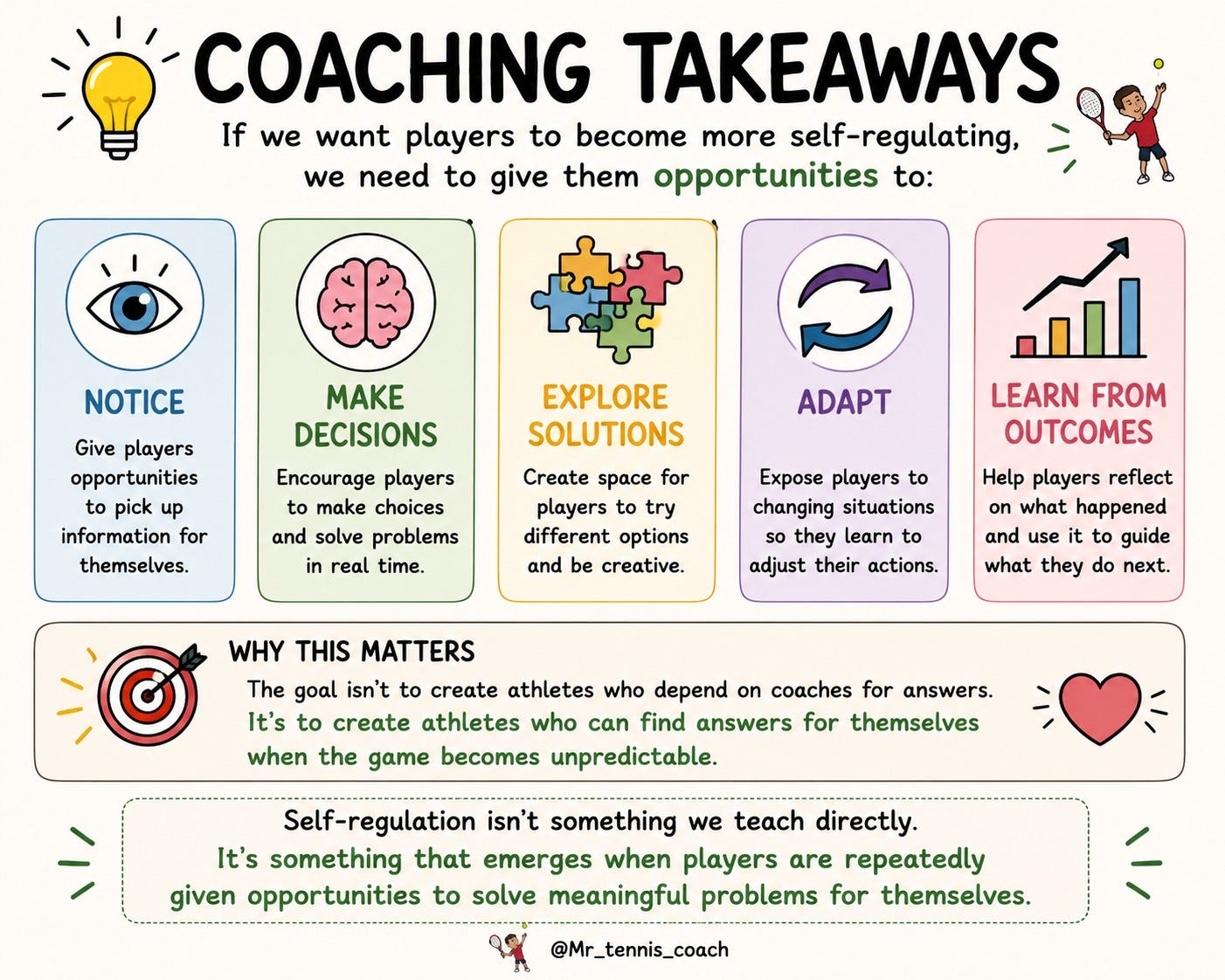
The key question is how do we actually develop players that can self-regulate? This graphic below goes through some of the key things we need to include in practice to develop self-regulating performers.
That’s all for this week
See you soon,
Philip

If you’ve been enjoying the newsletter, you might like my new website. It has links to some of my notes on my favourite research papers that you can check out if you’d like to explore some more skill acquisition ideas over the weekend.