
Loosely assembling, expanding the toolbox & more
Tackling pressure and adaptability in practice

It’s a Sunday newsletter this week, I was on track for getting it out yesterday but ended up having to go to the dentist for an inflamed gum which is the less glamorous side of travelling. I’m currently in week 3 of a holiday to Malaysia and we had lovely two weeks on the Perehentian Islands & Lang Tengah.
I’ve been enjoying the chance to catch up on a few podcast episodes and papers while taking a break from the heat of the afternoon sun. That’s enough of my rambling, lets get to the newsletter
Research Insights: Ecological Approach to MMA
Podcast Snip: Abundance precedes dexterity
Putting it into practice: Getting comfortable being uncomfortable
Research Insights
Applying an ecological dynamics framework to mixed martial arts training
1)We’ve recently talked about the coaching being a learning designer and what this might look like for coaches. You can check that out here if you’d like
this insight article seeks to discuss how coaches might consider re-aligning their role towards being designers of training sessions through creating tasks that invite various opportunities for (inter)actions (i.e. they are alive) to facilitate more skilled behaviour in mixed martial artists at all levels
2)Pressure and anxiety can act as constraints on performers and interfere with their ability to solve problems. Helping performers get more comfortable in these uncomfortable situations is going to be a key goal in practice
The psychological context of these lived experiences (i.e. pressure and anxiety) needs to be managed since it could potentially lead to fixed or rigid degrees of freedom (DoF) of the system (when thinking, perceiving, and acting; Chow, Davids, Button, & Renshaw, ), with the fighter unable to achieve expected performance levels.
3)I really like the idea of using a singular word or phrase to educate a performers attention and intention when performing. Overusing verbal instructions can impede a performers ability to effectively solve problems.
Rather than overusing verbal information and feedback that can impede opportunities for self-regulation (Davids, Button, & Bennett, ; Otte, Davids, Millar, & Klatt, ), educating a fighter’s intentions and attention using one word or simple phrases could offer a platform for authentic problem-solving
4)We want to give the learners lots of chances to explore different ways of solving problems so they develop an ‘abundance’ of solutions in their toolbox.
An abundance of usable system DoF provides a foundation for a fighter to transition to new behavioural patterns and adjust between functional states of coordination
5)a big misconception is that there is no session planning using the CLA. The session is planned is a loosely assembled way. This gives us the flexibility to make adjustments as we go rather than blindly following a session plan
Loosely assembled lesson plans provide coaches with opportunities to approach practice creatively as they vary these simple games while adding or removing elements of novelty and challenge.
Reference
Yearby, T., Myszka, S., Grahn, A., Sievewright, S., Singer, A., & Davids, K. (2024). Applying an ecological dynamics framework to mixed martial arts training. Sports Coaching Review, 1-28.
Podcast Snip
Abundance precedes dexterity
Shawn is one of the authors of the paper above and well known in the CLA world. This whole episode was fantastic and well worth a listen. The idea that abundance was mentioned in the paper above and it’s a crucial element of developing adaptable players. Having an ‘abundance of solutions’ means having the coordination to solve problems in lots of different ways. For example, in tennis this would mean rather than only being able to hit topsin on the backhand side you can hit with slice or flat also. Within shots you would also be able to vary the speed, height, depth, amount of spin etc. depending on the shot needed in the moment. This abundance allows you to functionally adapt to the emerging problems you are facing more effectively.
Putting it into practice
In the MMA paper above, the authors discussed the effect that pressure can have on performers. One of the biggest challenges we face as coaches is preparing players for the pressure of competition.
The reality is that we’re never going to exactly replicate the performance environment in practice. But just like with RLD the goal isn’t to replicate the performance environment exactly. Our goal with pressure is to gradually help players become comfortable being uncomfortable.
We can do this by designing activities that include appropriate levels of pressure. That pressure might come through:
Consequences that make decisions matter
Scoring systems that increase engagement
Scenarios that reflect common game situations
Challenges that encourage players to adapt
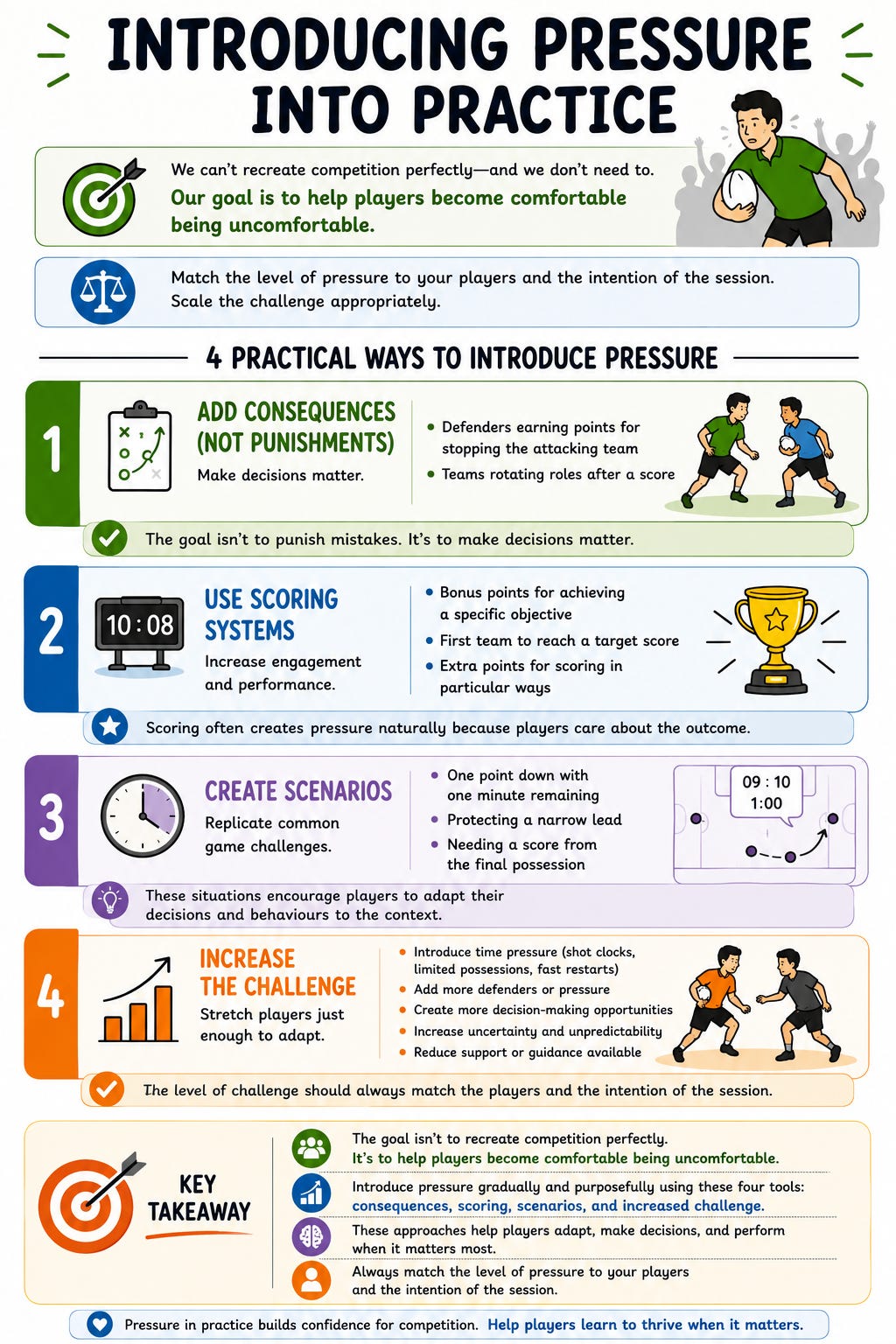
The important thing is matching the level of pressure to the players in front of you and the intention of the session.Our job as coaches is to find that sweet spot where players feel supported, but are still challenged to think, adapt, and perform under pressure.
It goes back nicely to a quote I often go back to by Damian Farrow “we’re motivated by our success, but we learn from our mistakes”
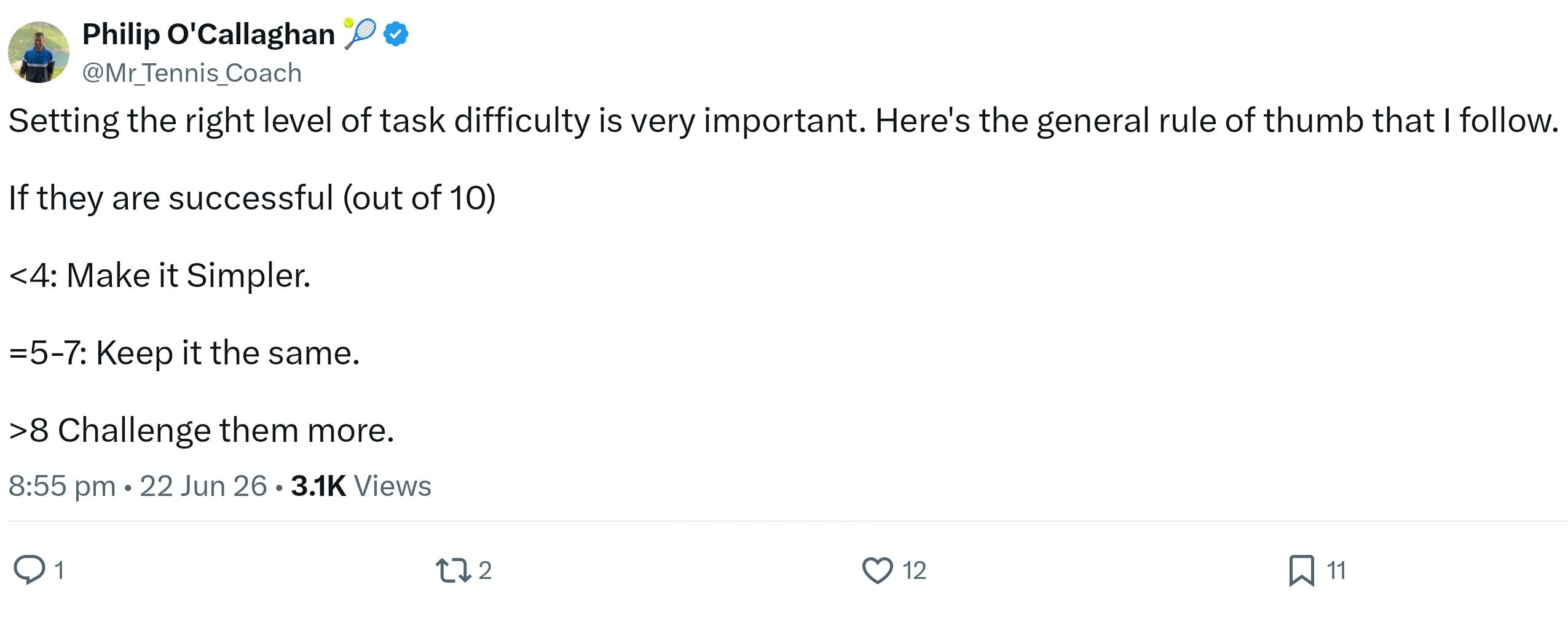
On X (@Mr_tennis_coach) this week I shared a simple rule of thumb I use in practice for this.
That’s all for this week,
See you soon

Philip
If you’ve been enjoying the newsletter, you might like my new website. It has links to some of my notes on my favourite research papers that you can check out if you’d like to explore some more skill acquisition ideas over the weekend.