Happy Saturday,
Before we get into this week’s newsletter, I wanted to share something I’ve been working on behind the scenes for quite a while.
Over the last year, I’ve spent a huge amount of my spare time building the CLA Coaching Blueprint, a course I’ve wanted to create for a long time. I’m finally getting ready to open it on the 15th.
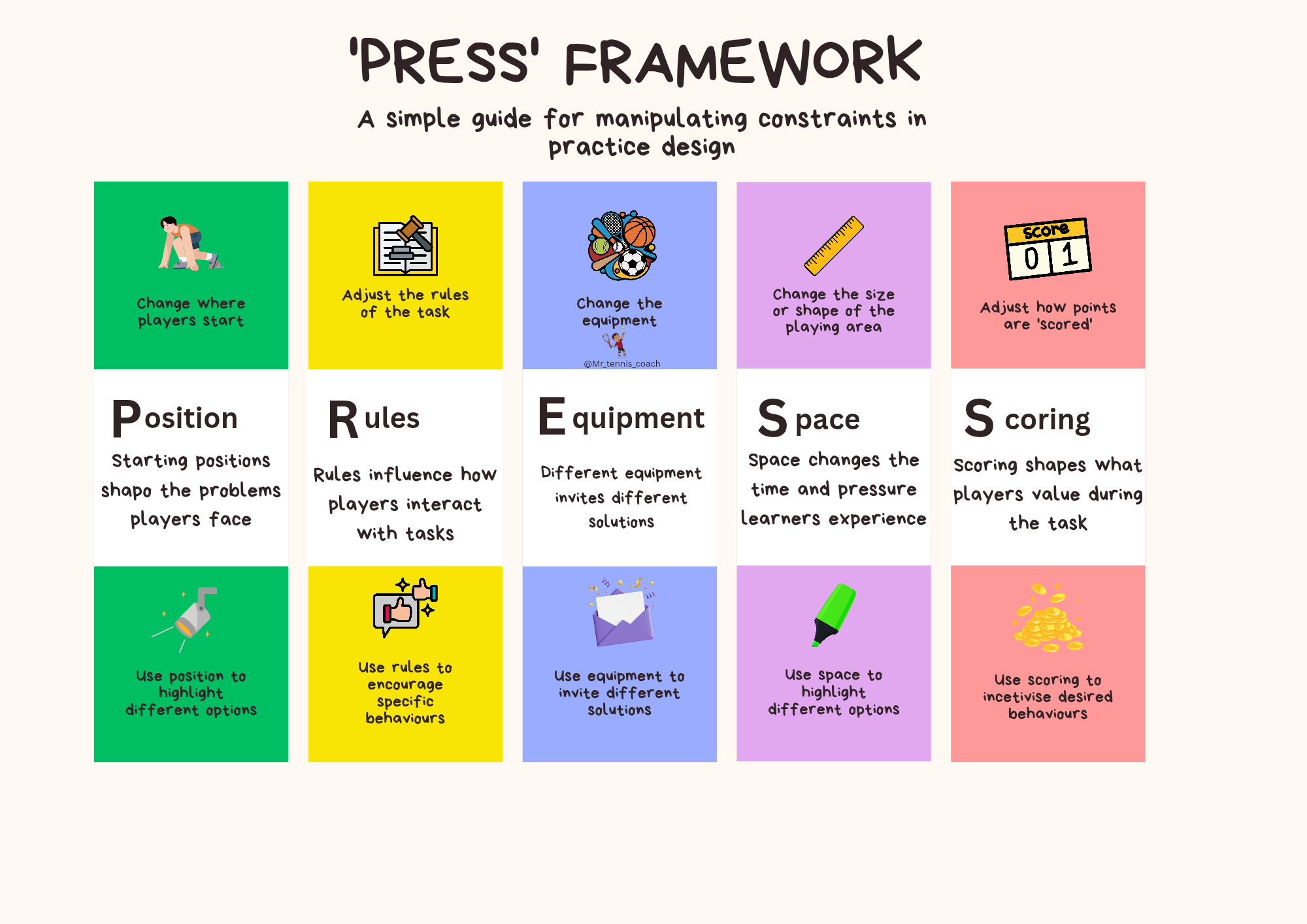
You’ll actually get a small sneak peek at some of it in today’s newsletter. I’ve included a few ideas and explanations adapted from the Blueprint, including a small part of the PRESS Framework I’ve developed to help coaches think more simply about manipulating constraints in practice.
That’s really what I’ve tried to do throughout the Blueprint. I’ve taken the ideas that took me years to piece together, stripped away the unnecessary complexity and explained them in a way that I hope makes sense to coaches, while always bringing everything back to what it means for the way we coach.
I’ll share a little more about the Blueprint over the next week, but for now, I hope you enjoy this week’s newsletter.
Research Insights
The role of nonlinear pedagogy in supporting the design of modified games in junior sports.
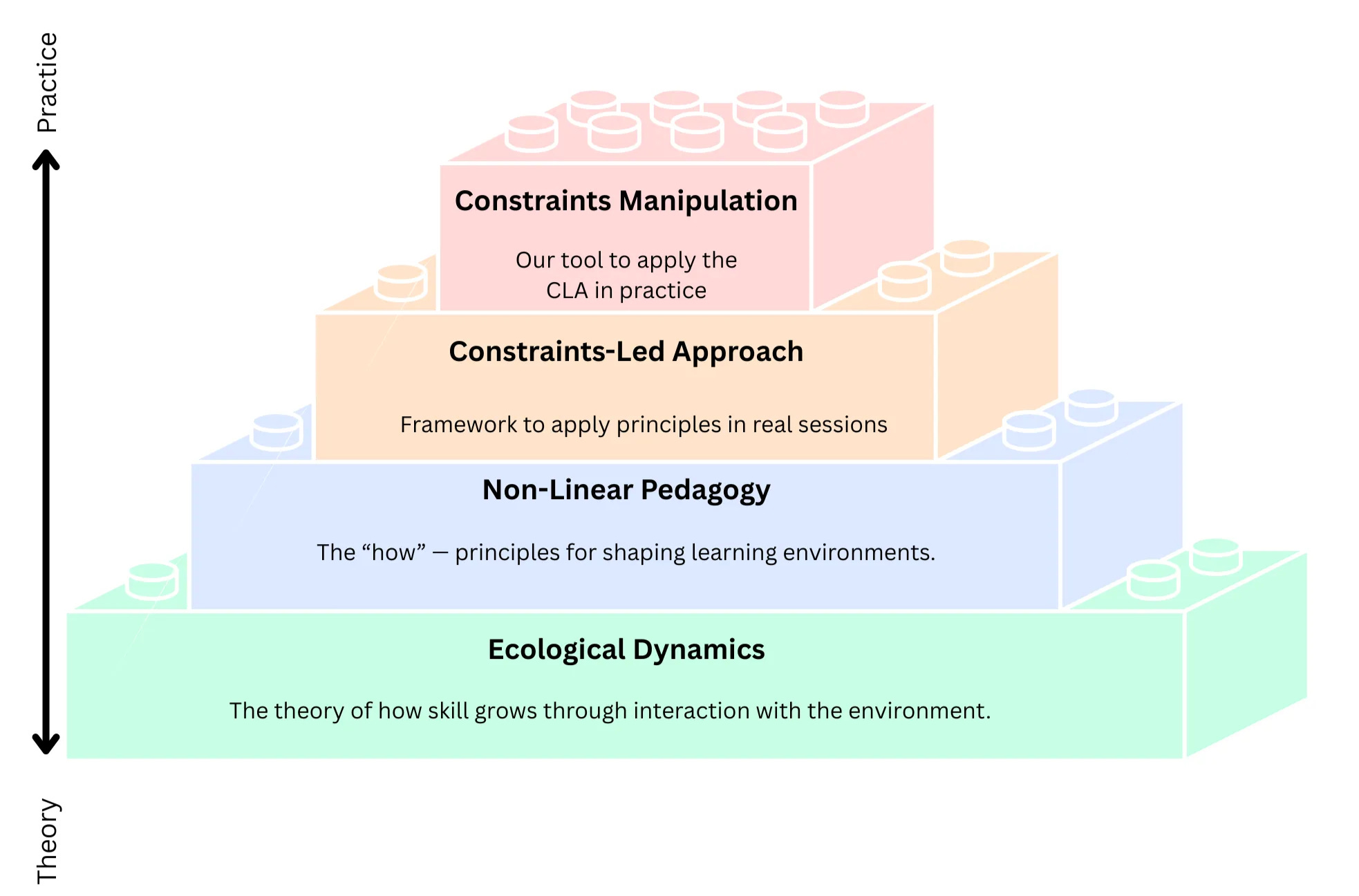
This paper is in my ‘must read’ category and I think every coach interested in the CLA should read. The paper explores how we can modify the design of games in junior sport. For those unfamiliar with Non-Linear Pedagogy (NLP) it’s 5 principles for learning based on Ecological Dynamics. In short, the main design principles involve making practice sessions more representative, simplifying tasks, considering the influence of information, incorporating practice variability, and manipulating constraints. If you’re trying to use the CLA, it’s crucial that you are aware of NLP. This is how I like to explain it (from my course)
Here are my 5 Key Insights:
1)Task Simplification is one of the most important things that we should be considering when modifying tasks. It’s about making the performance of the movement skill easier while keeping the perception-action coupling intact. The way I like to think of it is that we want reduce the complexity of the task while keeping the key DNA of the task present or ‘reduce without impoverishing’
Task simplification pertains to how practitioners could consider the importance of making performance of the movement skill easier to accomplish while keeping the perception-action coupling of the movement tight
2)From a CLA perspective functional does not imply the reproduction of technically ideal movement patterns, but rather behaviours that effectively satisfy the demands of a particular performance context. This happens when the tasks the we design match with what the learners are able to do
Functional movement behaviours emerge when the existing learner’s intrinsic dynamics meets the task and environmental dynamics
3)Variability is one way we can encourage the exploration of different movements behaviours. What’s really important is that we have the appropriate amount of variability for the level of the learners in front of us.
One would design the inclusion of such variability in practice to encourage a range of movement behaviours that are not repeated in the same way in terms of movement form but rather focus on engaging the learners to attain the task goal through a demonstration of these different movement forms
4)Constraints manipulation is the cornerstone of all design principles, as it supports the implementation of other principles. By manipulating constraints, practitioners can create practices that are more representative, simplify tasks, adjust informational constraints and introduce varying levels of practice variability.
The final design principle on constraints manipulation would seem to be the key pillar for all the design principles as it does underpin the enactment of the other principles. With constraints manipulation, practitioners can put in place more representative practices, simplify the task, tweak informational constraints, and of course infuse higher or lower variability in practice
5)When we design our tasks to suit the needs of the players in front of us it can really help guide the learning more effectively. For example, if we identify the rate limiter (learning handbrake) and reduce it’s influence this will help the learning
In that sense, if the modified game is specifically designed to those key constraints that control player’s behavior, it can become a power tool to guide learning
If you’d like to take a look at what the 5 key principles of Non-Linear Pedagogy are, I did a thread on these 5 years ago on Twitter you could have a look at.

Reference
Chow, J. Y., Komar, J., & Seifert, L. (2021). The role of nonlinear pedagogy in supporting the design of modified games in junior sports. Frontiers in psychology, 12, 744814.
Podcast Snip
Reduce without Impoverishing
Reduce without impoverishing was something that really stuck with me after Cal described it in this snip. The main idea is that we want to reduce the demands of the game to make it more accessible while preserving the key information players need to perceive. It’s one of the key premises of the paper above and one of the key ideas of implementing the CLA effectively in practice.
Putting it into practice
Press Framework
While constraints are the tools we use to shape behaviour, it can sometimes feel overwhelming to know what to actually change in practice. This is where the PRESS Framework can help. PRESS gives us a simple way to think about some of the most common ways we can manipulate constraints when designing tasks.
It’s important to note that PRESS doesn’t cover every possible way we can shape behaviour with constraints. Instead, it acts as a practical guide to some of the more common constraints manipulations we can make as coaches.
That’s all for this week.
I hope you enjoyed the newsletter and the small sneak peek at some of the ideas I’ve been working on for the CLA Coaching Blueprint. I’ll share a little more about it next week before it opens on the 15th.
See you soon,
Philip