

Before we get into this week’s newsletter, I just wanted to say a quick thank you to everyone who has checked out, joined or sent me a message about the CLA Coaching Blueprint since it opened this week.
It’s been great to finally get something I’ve spent so long working on out and I’m looking forward to seeing how coaches use it over the coming months.
Anyway, onto this week’s newsletter...
Research Insights: Affordances in Sport
Podcast Snip: What does the gap perceive
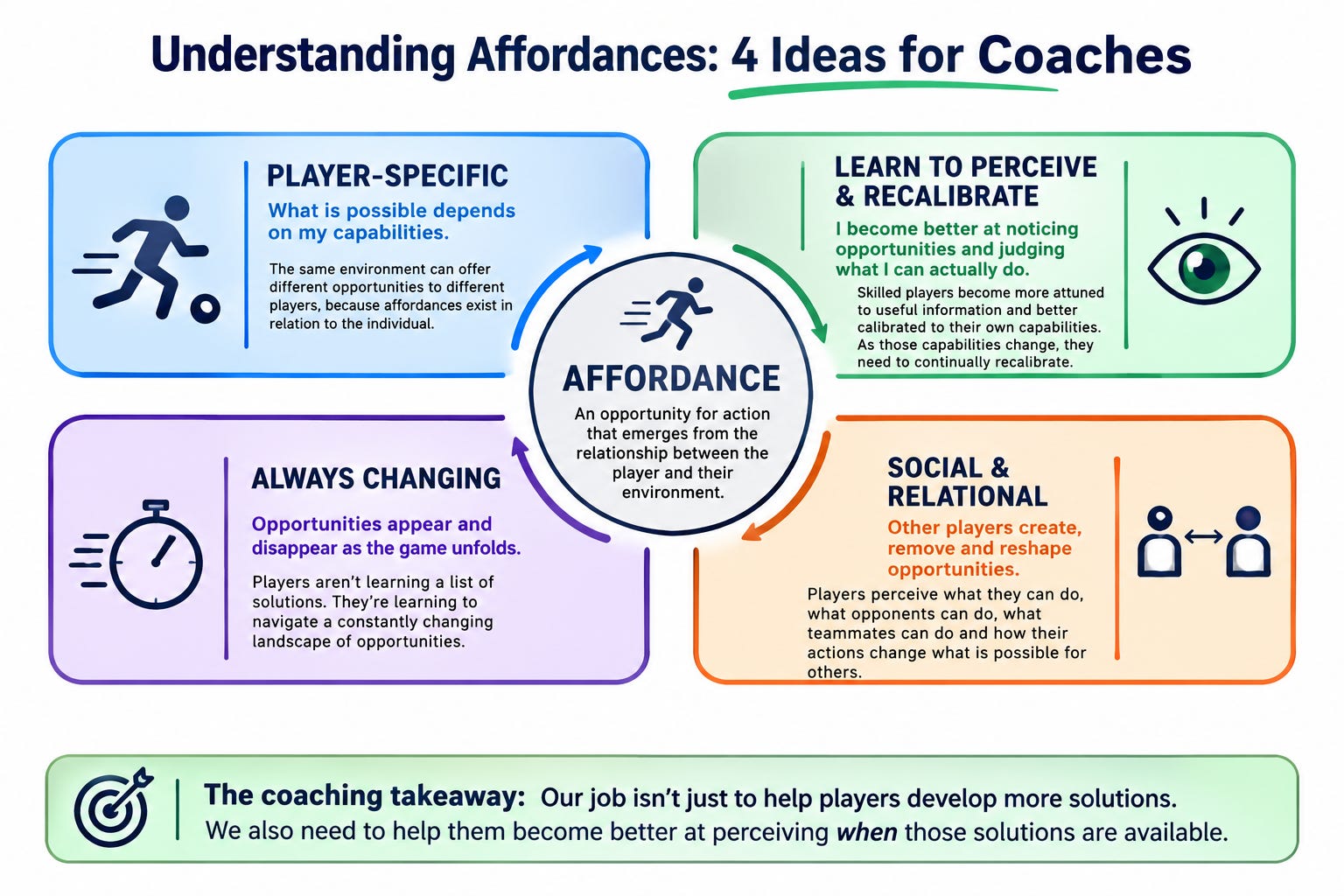
Putting it into practice: Understanding affordances for coaches
Research Insights
This paper is quite theoretical but is one that I go back to revist often as it’s on such an important topic. Affordances are one of the foundations of the CLA and this paper does a fantastic job discussing their application in sport. Narrowing it down to 5 insights was tricky but I tried my best to pick out the ones that would help coaches grasp the concept better.
Here are my 5 Key Insights:
1)Affordances are dynamic, shifting in response to both changes in the environment and the athlete’s actions. This is why developing the ability to problem solve effectively requires the ability to better perceive and act on affordances
Affordances may arise and dissolve with movements of the actor even though the surfaces and substances in the actor’s environment remain static, or as changes occur in the actor’s environment while the actor remains static. (View Highlight)
2)Perceptual attunement highlights how experts and novices differ in the information they rely on, with experts focusing on more relevant cues. Perceptual learning is about becoming better at noticing the ‘affordances’ that support successful action and this is where RLD becomes so important
The notion of perceptual attunement implies that differences between experts and novices reflect, in part, differences in the informational variables upon which experts and novices rely. (View Highlight)
3)Calibration is knowing what opportunities are available to you based on what you can currently do while recalibration is continually updating that judgement as you or the environment changes. These are going to be crucial for successful performance
In perception and action, calibration and recalibration are necessary to establish and update the mapping between the units in which the relevant properties of the world are perceived, and the units in which the action is executed (View Highlight)
4)In the paper, they divide ‘social affordances in sport’ into three types:
Affordances for another person: perceiving what others are capable of doing. For example, if a player knew they were faster than their opponent they could run past them
Affordances for joint action: what can a player do with another person. Could be a give and go or working with a teammate to close down an attacker
Affordances of another person: what opportunities does another player create for you. If a player made a run that opened up space for example
Three categories of social affordances; Affordances for another person (i.e., what actions another person can perform under a given set of environmental conditions) ),affordances for joint action (i.e., what actions can the perceiver and another agent or agents perform cooperatively), and affordances of another person (i.e., what actions another person afford the perceiver
5)I thought this was a really nice practical example from the paper that explains affordances in action really well
For a soccer player, the field presents various affordances based on the player’s skills, the positioning of teammates and opponents, and the ball’s location. A pass, for instance, is only an affordance if the player has the skill to execute it and a teammate is positioned to receive it. Additionally, as the player moves and as opponents adjust their positions, the field’s affordances continually shift. The player must perceive these dynamically changing affordances in real-time, making quick decisions to control actions effectively toward achieving goals, such as advancing the ball or maintaining possession
Reference
Fajen, B. R., Riley, M. A., & Turvey, M. T. (2008). Information, affordances, and the control of action in sport. international Journal of sport psychology, 40(1), 79-107.
Podcast Snip
This is a snip I shared before but I think it’s one of my favourite explanations of affordances for coaches by Mark O’Sullivan. If you don’t know who the players are a basketball example would if two players found themselves in space just outside the 3 point arc, we’ll take Steph Curry and Giannis Antetokounmpo. Due to Steph being the best 3 point shooter of all time, he may perceive the opportunity to shoot a 3 pointer. Whereas, Giannis may perceive the opportunity to drive towards the basket as this would suit his capabilities more.
Putting it into practice
Understanding the theory behind affordances is really helpful but it’s knowing how they will influence our coaching is what really matters. I tried my best to distil affordances into 4 key concepts for coaches to use in practice. The graphic is one that I’ve used in my course and provided a much deeper explanation into these 4 ideas there also.
Take your understanding of the CLA further
If you’ve been enjoying these newsletters and want to go deeper into the ideas behind the Constraints-Led Approach, the CLA Coaching Blueprint is now open.
I’ve brought together the ideas that took me years to piece together into a clear learning journey designed to help you not only understand the CLA, but apply it in your own coaching.
Alongside the complete Blueprint, you’ll also get practical frameworks and resources, ongoing support as you work through the course, access to the Blueprint community, monthly live Q&As and four practical workshops over the coming year.
The introductory price is €250.
If you’d like to take your understanding of the CLA further, I’d love to welcome you inside.
→ Explore the CLA Coaching Blueprint
That’s all for this week.
Talk soon,

Philip